Seeking the “Secret Sauce” of a Nishiogi Favorite

In Nishiogi, as in other neighborhoods, there are corners where businesses seem to come and go so quickly that you can no longer keep track of what used to be there. And then, in just such a place, one eatery catches hold of Nishiogi’s finicky customers and, almost before anyone notices, becomes part of the everyday life of the neighborhood. Why does such a place take root? In a location where other delicious, well-conceived establishments have failed to last, what is it that draws people in and brings them back? It is always intriguing to investigate the “secret sauce” of an emerging Nishiogi favorite.
LORO Kitchen is one such place. Supported by a fiercely loyal group of regulars, including women who work in Nishiogi, it has become known as a place for a small, everyday kind of indulgence. And what is most surprising is that, despite having become so rooted in the neighborhood, even LORO Kitchen is now preparing to move out. The good news, though, is that it is neither closing nor leaving Nishiogi.
A business’s recipe for success cannot be explained by a single ingredient. For LORO Kitchen, it is a medley of the couple’s personalities, their way of doing business, the unexpected paths that brought them here, and their very different style of relating to customers. Mixed, these elements keep people returning again and again to the counter as a contact zone between staff and regulars. The story begins with a slightly unlikely encounter: a funky woman raised in Nishiogi and a takoyaki vendor from Shimane. “I ran a takoyaki shop in Shimane for twelve years. My father was the one who started it, the takoyaki business. He had always been in the business of selling CDs, DVDs, and games, but then personal computers became widespread, and downloading started. He thought the business of selling CDs might be over; we should stop. If we kept inventory, we would fall into the red, so he started takoyaki as a business that did not require holding stock.
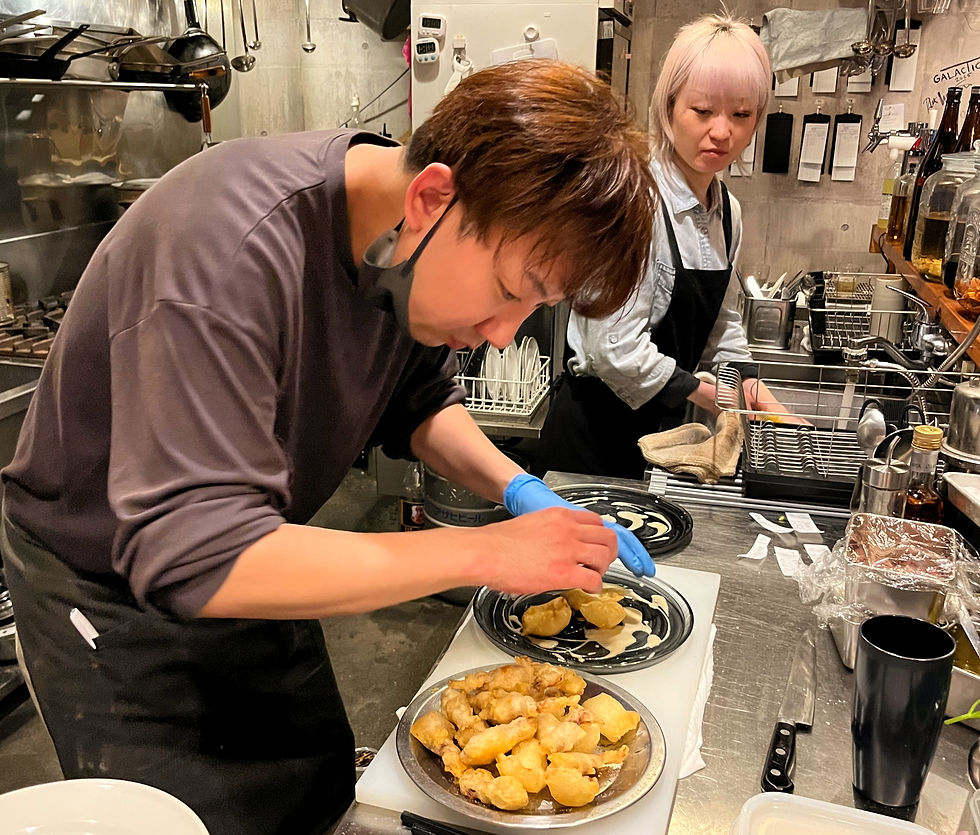
At that time, there was a takoyaki boom in Shimane. After about eleven years, we had almost paid off the debt from the old retail business. Once things had settled down, I said, ‘I’d like to study cooking, so please let me go to Tokyo.’... I was the eldest son of a family in the countryside, so I do feel bad about it. I was supposed to be the heir. I turned away from that, and now my older sister has taken over my father’s company. At first, I was helping the family.”
Those years in Shimane remain one of the driving forces behind Naoyuki’s sense of commerce. Carrying his feelings toward his family with him, he chose to challenge himself in Tokyo and eventually put down roots in Nishiogi. “That’s why, when our anniversary comes around, we make takoyaki here. Once a year, we hold a takoyaki sale. We don’t do Italian food at all. For three days, we just keep making takoyaki.”
For those three days, he takes down the Italian signboard, so to speak, and does nothing but make takoyaki. It is a kind of ritual, a gesture of respect for his family history. Asked whether he gives the takoyaki an Italian twist, Naoyuki shook his head. “No, I don’t do that. Sauce, mayonnaise, bonito flakes, and aonori. That’s the most delicious way. The real thing. Ponzu and things like that are good too.”
Nanaka, by contrast, is a city girl from Nishiogi. “That’s right. Shōan Elementary School. I’ve been in Nishiogi since I was a child. For a while, I lived in Nakano for about ten years, but this restaurant brought me back to Nishiogi.”

An encounter in Mitaka, and a reckless challenge at thirty-two
Their meeting goes back to Naoyuki’s training days in Tokyo. “I was working in Mitaka, and Nanaka was the girlfriend of one of my coworkers there. We thought about all kinds of things in life and became best partners. Nanaka is a musician, so the two of us really come from totally different genres.”
Naoyuki began pursuing cooking in earnest at the age of thirty-two, which is by no means early for a cook.“I wanted to run a place with takoyaki and alcohol. But at that time I couldn’t cook, so I thought I should study cooking and came to Tokyo when I was thirty-two. I said, ‘Please teach me how to cook,’ and at the restaurant in Mitaka they taught me everything, starting with how to hold a knife. I worked there for about six years. At that time, Nanaka was working at a spice izakaya. When she quit, I also went there and worked for just one year, but I thought, this isn’t quite right, and then I went into Italian food.”
Naoyuki looks back on that first restaurant in Mitaka, where he trained, in this way. “The place in Mitaka was an izakaya where anything went. They had pizza and pasta made from scratch, sashimi, takoyaki, fried skewers, mapo tofu... They had everything. It was an independent shop, but amazing, right? Usually, places that do all kinds of different things like that aren’t really so good, but everything there was really delicious. It was wonderful, and I was lucky. At the first place where I worked, I could learn Chinese, Japanese, and Western food, everything. I thought that if I was going to have my own place someday, I needed one ‘pillar,’ so I chose Italian.”
The next place Naoyuki went was a restaurant called Eccomi, then located in Hōnan-chō and now moved to Hamadayama. “It wasn’t so much Italian in the usual sense as Italian leaning toward French. The plating was very beautiful, and the flavors were good. The chef was younger than me, but he hired me and taught me. The restaurant was called Eccomi. In Italian it means something like ‘I’m here’ or ‘Here I am.’”
A “jinxed” property in Nishiogi, and people with “a strong sense of self”
Why did they come to Nishiogi? At first they had been planning to open in Ogikubo, but the plan fell through because of issues on the landlord’s side. As if guided by fate, they arrived here instead. “At first, we were planning to do it in Ogikubo and were looking at properties there, but it fell apart because of a problem with the landlord. When we started looking for another place, this one happened to come up, and we applied right away. I just wanted to open a restaurant as soon as possible. We were lucky. This location is really good.”
Even so, the present LORO was not completely their own business from the start. It had originally been opened by another owner who ran a restaurant in Asagaya, and Naoyuki and Nanaka spent the first year standing in the restaurant as employees. “After one year, the owner said, ‘You two should run this place yourselves,’ so in terms of our own management, it has been two and a half years.”
But once they moved in, they discovered a strange rumor about the place. “Apparently, this place has a bit of a history. All kinds of shops have been here, but none of them lasted even one or two years. They kept changing over and over. But we’ve been here three and a half years now.”
No one knows exactly why earlier businesses were so short-lived. But as the two continued to run the restaurant here, they gradually became aware of the difficulties of using the building as a restaurant. Since the landlord lives upstairs, they inevitably have to be careful about voices and sounds from inside the shop late at night. Their contract says that business hours end at eleven, but when regular customers are enjoying themselves, it is not always possible for everyone to get up and leave immediately after eleven. That gap in timing sometimes created friction. Naoyuki acknowledges that there were things they themselves needed to be considerate about, but it is difficult to tell customers who are enjoying themselves, “All right, please go home now.” The accumulation of these small tensions over sound and time became one reason for thinking about a move.
What allowed them to overcome that “jinx” and keep the restaurant thriving for three and a half years was the deep relationship of trust they built with the distinctive customers of Nishiogi. Naoyuki analyzes the subtle relationship between cooks and customers in this neighborhood. “Nishiogi is interesting. There are a lot of strong chefs here, chefs with really strong personalities. But because they do reliable work, the customers understand. The fact that our stance is working now may also be because this is Nishiogi. It might be difficult elsewhere. Customers in Nishiogi are understanding, and they have all kinds of sensibilities. They might go to a Michelin-starred restaurant and also say Saizeriya is delicious. I think that’s wonderful.”
At times, however, that “understanding” comes with a sharpness that can make even professionals tremble. “Their palates are refined. They really know a lot. They cook themselves, too. So it’s scary. If something isn’t good, they’ll tell you properly. A new place opens, and people say, ‘Have you been there?’ ‘Not yet.’ ‘We went. I don’t think you need to go.’ Things like that.”
Nanaka also paints a picture of the people of Nishiogi she has observed from across the counter. “There are many people with love for Nishiogi. If I had to put the characteristics of Nishiogi customers into words, I would say they “have a strong sense of themselves.” Everyone really does their work properly. I don’t ask what kind of work they do, but later I sometimes find out they were incredible people, and I’m surprised. But they don’t say that here. Here, they just enjoy themselves as ordinary drunks. They are solid human beings, and they live carefully. It is interesting to hear stories from people like that. They don’t tell stories they read in a book; they tell stories they experienced themselves, in their own words, so it’s really interesting. It’s like reading a nonfiction book every day.”
Naoyuki says that whenever he drinks in other neighborhoods, he rediscovers what makes Nishiogi distinctive. “You understand it best when you drink in other neighborhoods. When I drink somewhere other than Nishiogi, I think, ‘This food is good, but in Nishiogi it would be cheaper, and there would be more of it.’ It’s peaceful, and there are many good places. Rather than going out of my way to drink somewhere else, I come back and drink in Nishiogi. To heal myself. To eat slowly with someone important. When you eat while worrying about other people, you can’t taste anything, right?”
The reason they cannot leave this neighborhood lies in the intense time spent with the people of Nishiogi: people with demanding palates who nevertheless treat food as a central part of their own lives.
This sense of something that is “part of life” also appears in the way regulars use the restaurant. According to Naoyuki, about “sixty percent” of the customers are regulars or super-regulars, and some come three times a week. Still, LORO is not simply an inexpensive izakaya. “Compared with the izakaya around here, we are a little more expensive. We really do the cooking carefully as a restaurant, so it’s a bit of a ‘small indulgence.’ But we also want this to be the kind of place people can use even three times a week, so we have Hoppy too. It makes the place approachable. Of course, we have wine, and we have green tea highballs. We also have the kinds of things you would find at a Japanese izakaya.”
The philosophy and menu secrets of “more than an izakaya, less than a restaurant”
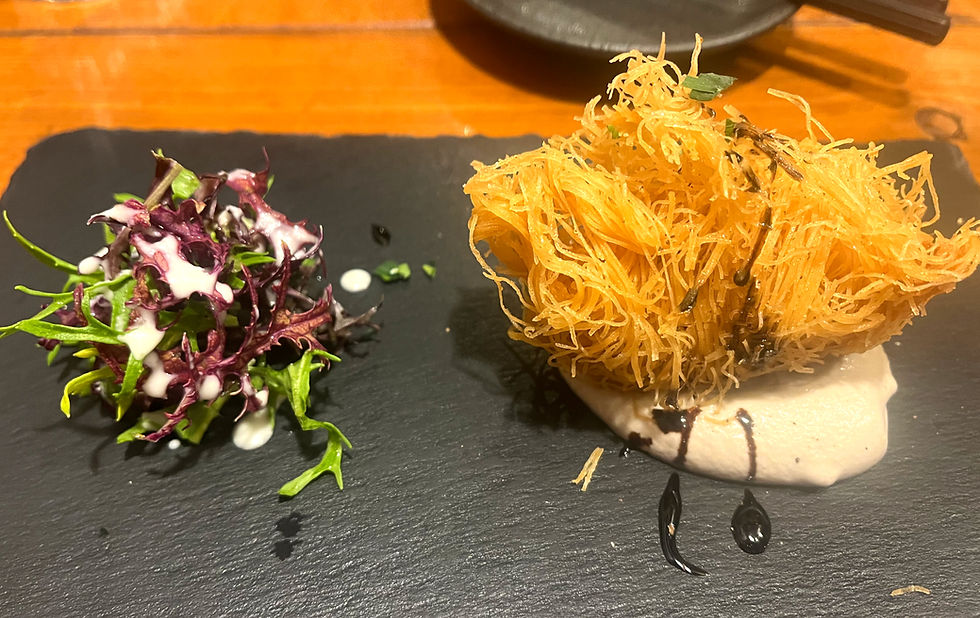
The theme Naoyuki has set for the restaurant is clear. “I had always wanted to run an izakaya, but there are so many izakaya, aren’t there? So to make ours different, I made the theme ‘more than an izakaya, less than a restaurant.’ The idea is, how about enjoying the good things from that middle ground, in the atmosphere of an izakaya? The theme is customers cheerfully becoming friends with one another.”
“As for the food, for example, if a young couple goes to an expensive restaurant, the hurdle is very high. There are manners and ways of eating, and they may not know what to do. I’d like them to use a casual place like ours as one step, as a cushion, as practice for getting used to that kind of food. It’s like a place where you can enjoy food of higher quality than an izakaya.”
Supporting that culinary quality is Naoyuki’s constant tinkering. Nanaka explains it this way. “LORO is a place where we want people to be moved. His food is always changing. The regular menu changes, and the daily menu changes completely every one or two days. So the next time you come, the previous menu is already gone. You may never be able to eat it again. There is that kind of pleasure. Using seasonal ingredients, using all kinds of delicious foods from Japan at the moment when they are most delicious - that is our concept, right?”

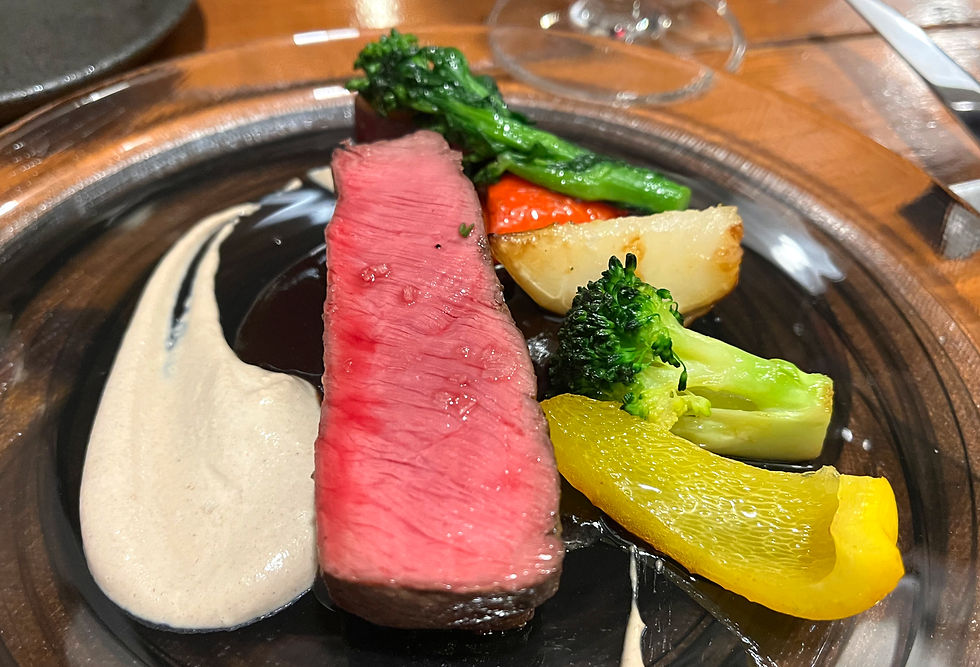
For Naoyuki, conjuring up a menu that changes every time is not easy. When asked how the menu is decided, his particular way of working becomes visible. “I am always thinking about the menu every day. For example, if I go to the greengrocer and fukinotō (butterbur), a spring ingredient, has come in, I think, ‘I want to use this fukinotō. Should I make it into a sauce? If I make a sauce, what should I pair it with? Meat, fish, maybe shellfish?’ I think through various things and then decide, ‘This is it. If it’s fish, white fish rather than red.’ Fukinotō by itself has a bitterness, so maybe I should add a refreshing citrus, and so on. I am always thinking about those things in my head. Even while I am preparing today’s menu, I am thinking about the recipe for the next dish.”
“I look at the internet too. I look at YouTube, and I look on Instagram at dishes from other restaurants. But I absolutely never make exactly the same thing. Most of my customers are Japanese, so I use ‘Japanese’ as a theme. I use soy sauce and mirin too. The base is Italian, but Japanese elements and flavors are in there as well. I also put in Chinese elements. I might simmer pig’s feet for about ten hours, make them into a paste, and use that paitan in a sauce or in pasta. So it’s a strange kind of Italian food. But I think if it tastes good, it’s okay. It has to taste good. If it tastes good, honestly, even if it isn’t Italian, if the customers are happy, then I think that’s fine.”
That flexibility also appears in his distance from Italian cuisine itself. Naoyuki does not dress up his cooking as authentic Italian. “Actually, I only worked in Italian food for two years, so I’m not that knowledgeable. I don’t really know the names of the sauces that people at more orthodox restaurants use. I think, wow, that’s amazing, but... At our place, the sauces are good, so I feel like that’s our strength.”
Conversation with regulars can also become the trigger for a new dish. But Naoyuki does not make things exactly as requested. “Sometimes I do. But I absolutely never make it exactly the way they say. For example, with pasta, when I’m thinking, ‘It’s about time to change the pasta,’ I’ll ask a regular, ‘What would you like to eat next?’ If they say, ‘I want shrimp,’ then I think, ‘What should I pair with that? Tomato might be good,’ and that has become a menu item before.”

Distance from customers, and respect for the food
Even in the lively atmosphere of the restaurant, there are lines the two of them will not cross. While they value conversation with customers, Naoyuki is firm with anyone who disrupts the atmosphere of the place. “We do talk with customers a great deal. But if a guy comes in aiming to pick up someone, I ask him to leave. If customers become friends and drink together happily, that’s fine. But if it turns into, ‘Give me your contact information,’ I say, ‘Please don’t do that.’ This may be our own ego, but I don’t want anything to happen that might make someone feel uncomfortable, so I stop it.”
Behind Naoyuki’s words is not only a matter of manners. There is also an urgent desire for people to taste the food he serves in its best possible state. As if supplementing his strictness as a craftsman, Nanaka continues. “More than anything, what I hate most is for the food he makes to become bad. Everyone who comes here is a gourmet and loves food. When the pasta is ready, I want them to eat it while it’s hot, but if they keep talking and it gets cold... We have to say, ‘Please don’t get in the way of her time alone with the pasta.’ Yone-san really says these things properly.”
Naoyuki’s words may sometimes sound harsh, but everything is for protecting the energy he has poured into a single plate. “I say, ‘Please leave,’ or ‘You don’t have to come back.’ People who talk about things that aren’t fun, things you shouldn’t talk about in a place where people are eating - I send them out in very direct language. Many people come here as a reward after working hard all week, so we have to value that time for them. I think we have to protect it.”
That atmosphere is not made by Naoyuki alone. Naoyuki concentrates on cooking while Nanaka watches the room and creates the place. That division of roles is what sustains LORO. “I think the food has been appreciated too, but during service I often focus on the cooking and don’t talk much with customers. Nanaka keeps them entertained and handles the front of house. As you can see, I’m an extremely shy and quiet man.”
When he is cooking, Naoyuki becomes, in his own words, truly a craftsman. “It takes time, and it isn’t something I can just put out quickly, so I really don’t have any leeway.”

Flavors that cross borders, and resonances with the world
The flavor of LORO captivates not only the local world of Nishiogi but also customers from around the globe. “Recently some Italians came too. One of them started out with this mood of, ‘I’m not feeling well today, so I’m not going to eat much.’ But after he ate the otōshi, it was like a switch flipped. After he ate it, he said, ‘A hundred more otōshi!’”
“The otōshi that day was a little interesting. It was chicken fritto with a burdock sauce. Burdock doesn’t grow in Italy, so there isn’t burdock in Italy or Europe. First of all, he was moved by that, and then he said, ‘I’ll eat this and that!’ In the end he ate two kinds of pasta. Then he suddenly started writing something over there with a marker. Later we heard that he was apparently in Italy’s official Bob Marley tribute band. It was funny.”
On the wall there are also signatures from Galactic, the New Orleans band that has headlined Fuji Rock. “We don’t ask our customers about their work, their names, or their ages. Then, after we had been friendly with one customer for a long time, it turned out that he was a translator. Those band members love Japan, but they were already tired of Asakusa and Shibuya, tempura and sashimi. They wanted to eat something new and delicious from Japan, so they came to us.”

A new building, a new challenge
At the new location they plan to move to this year, they are also planning to open for lunch.
When they were looking for a place to move, they considered other neighborhoods as well. But the regulars’ voices were clear. “We had a hard time finding a property. We thought about other stations too, but all the customers said, ‘Even if it is farther away, please keep it in Nishiogi.’”
“I do all the cooking by myself. It’s difficult. I want one more person. The new place will be about one and a half times as large as this one, but the number of seats will be only a little more than here. I want to start lunch, so I am looking for one more staff member. At first, I will do it myself, but I want to teach someone thoroughly, to the point where I can entrust it to them.”

Carrying with them the bonds they have built with regular customers in Nishiogi, the two now head toward a new stage: the fourth floor of a new building. While Naoyuki pours his heart into each plate in the kitchen, Nanaka continues to enjoy conversations with the not-so-easily-classified people who gather in this neighborhood. “You understand it best when you drink somewhere that isn’t Nishiogi. It’s peaceful, and there are many good places. The characteristic of Nishiogi people is that they ‘have themselves,’ I think. It’s really interesting every day. It’s good work.”
In those words, one senses a deep affection for protecting a place where people cross paths, a place that does more than simply serve food.
At the end, Naoyuki seemed full of expectation for the new stage that is about to begin. On the fourth floor in Nishiogi, in a place closer to the sky, the couple’s “izakaya spirit” is preparing to soar even higher. (James Farrer and Sakura Yajima. Interview March 14, 2026. Published June 3, 2026. Copyright by James Farrer, all rights reserved.)


