Where Do the Cups Go When a Coffee Shop Closes?
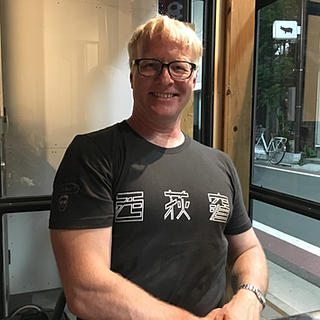

An aroma of freshly brewed coffee and ketchup from the Napolitan spaghetti circulates through the earth-toned store as customers focus on their books and sip from vintage English-style coffee and teacups. Shelves of antique sugar pots, coffee-bean canisters, and glassware glisten against the windowpanes. Tables, chairs, and small crates filled with paintings, knickknacks, and coffee ware are set up outside, where young residents and visitors from overseas browse without disturbing the patrons inside. Murata Shokai is a café serving coffee, small meals, and sweet treats. Remarkably, it is also an antique store that resells furniture and items from Japanese kissaten that have closed, giving a second life to these relics of Japan’s unique postwar coffee culture.
For owner Murata Ryuichi, the buying and selling came first. He had been running an online shop under the name Murata Shokai for three or four years before opening the café in 2019 with his wife, Tomomi. The idea for that business began when he was around 25 years old and still a company employee. A kissaten he frequented put up a sign saying it was closing. Showing us a photograph in his book, Kissaten no isu to tēburu (The Chairs and Tables of Kissaten), Murata recalled what happened. “When I was still working as a company employee, around 25,” he said, “there was a kissaten I used to go to, and it put up a notice saying it was closing. I really liked it and had been there a number of times, so when it was closing, I was really shocked. I asked, ‘Master, are you really closing?’ and he said yes. I asked, ‘What will happen to these chairs and tables?’, and he said, ‘They’ll be thrown out, so if you want them, you can have them.’ So, I said, ‘Well then, I’ll take them,’ and these are what I brought home [pointing to a photo in the book]. I still use them at home.”
“So, because of that experience, I’d always felt that things used in kissaten were really appealing. But of course, old shops keep closing one after another, and when that happened, I’d sometimes talk with the people running them. In most cases, the things just got thrown away. I came to realize there were almost no dealers who would buy these things and sell them again. It’s probably not something everyone wants. Even if there weren’t many people who’d want them, I thought people who loved that particular kissaten would buy them if I put them up for sale, and that’s how I started.”

More than a Café
While pursuing his reselling business and purchasing furniture from closing kissaten, Murata had not planned to open a café in Nishiogi. “Then I heard this place was closing,” he said, “so I came to talk to the master here. At first I came to say, ‘If you’re going to throw this furniture away, please let me buy it.’ Then the master told me that although he was closing, if someone else wanted to carry it on, he’d be fine with them taking it over.”
“I hadn’t been dreaming of running a kissaten all along, but when I heard that, I got this urge to give it a try. But I was also running the buying-and-selling business, so I thought jumping straight into running a kissaten would be hard. I asked around among people I knew, ‘Does anyone want to take over this shop?’, but I couldn’t find anyone right away who said they wanted to. I thought, if nobody takes it on, it’ll be torn down. So I ended up saying, ‘All right, I’ll do it.’”
Living in Shakujii-kōen in Nerima Ward, relatively close by, made the location convenient. The shop also offered a way to continue his existing business. “At the time, although I live around here now, I was living in Shakujii-kōen in Nerima Ward, which is fairly close, so at first I commuted to the shop by bicycle. So it was close to home, and it was just the right size for running on my own. A big place would be hard work, so I liked the size. Above all, there was space outside to put things out and sell furniture. I thought I’d rarely come across a shop with such good conditions again, where I could keep doing my existing work and run a kissaten too. So I took the plunge, said I’d do it, and was allowed to take it over just as it was. That was 2019, I think.”
Murata already knew the café as a customer. Taking it over allowed him to keep much of that familiar setting intact. “Well, I’d been here a few times before I took it over. It was a shop called Pot, and I’d come a few times in the Pot days.” Pointing to a surviving logo or a sign from Pot, he showed how traces of the earlier shop remain in the space. “It’s hardly changed,” he said with the open satisfaction of a connoisseur of kissaten’s past.

Objects and their stories
As a reseller, Murata does more than simply list the items as objects. He allows former customers to take something of a favorite café home with them. “On top of that, rather than just selling them as objects, I sold them openly, saying ‘this was used at such-and-such a shop.’ Because of that, people who had been customers of that shop quite often bought them.”
“In that sense, doing it as an online shop worked out well, I’d say. News that such-and-such a place has closed is rather sad news, but it tends to spread, to get shared. So posts like ‘this shop has closed, and we’re selling its chairs’ got shared quite widely. The information reached people who wanted those things, even people I didn’t know, and quite often they bought them.”
The buyers include both people furnishing their homes and those opening or running cafés of their own. “Well, about half and half. About half buy for their own homes, and quite often people who want to open a shop like this, or already run one, buy a fair amount in one go. So it’s roughly fifty-fifty. If I sell ten chairs, about half go to shop owners and half to individuals.”
The work begins with making contact with a shop that is closing, deciding what can be sold, and arranging to collect it. “Yes. There are various patterns. Sometimes I hear a place is closing and go directly to talk to the master. But nowadays it’s mostly that the kissaten sees my website and contacts me. When I get a call, I go and look. Inevitably there are things I can buy and things I can’t, so I tell them, ‘I can buy these, and it comes to this much.’ Then on another day I go with a truck and take everything away.”
“Basically, it’s anything in a kissaten that can be sold. But the main things are chairs, tables and tableware. Then, more unusually, paintings hanging in the shop, shelves, and sometimes fairly large pieces of furniture.”
Leafing through the book, he points out some of the smaller objects he has taken in.
“Ah, yes. [showing pages in the book] Sugar pots like these, coffee-bean barrels [canisters?], and things like this too. [Food] samples. They’re not real food, but I took those in as well.” The photographs also show how the pieces are loaded onto a truck. Murata keeps a warehouse in the neighborhood where he used to live. “The warehouse is still over in Shakujii-kōen, where I used to live, and I go back and forth between there and here moving things.”
Although kissaten are his main source, the business sometimes reaches into other kinds of restaurants. His website, for example, includes the story of Tomiya, a prominent neighborhood Chinese restaurant by the station’s south exit, from which Murata sold a range of items after its closure.
Some of the glasses stay at Murata Shokai to be used rather than sold. The objects that furnish the café are also part of its stock of stories. “Yes. The glasses we use here were mostly used at other shops, and I decided to keep them for our own use rather than sell them. This, and this kind, and the glasses around here.”
The book itself is sold in the shop. It predates the opening of Murata Shokai as a café and therefore does not include this place. The website, with its accounts of the old shops, is written by Murata and Tomomi together. Asked whether another book might follow, he says he is too busy for now.

What is a kissaten?
By working with the original owners, Murata helps keep furniture and tableware in use after the shops themselves close. Asked what is driving those closures, he points above all to the aging of the people who opened them.
“Well, a lot of kissaten opened in Japan in the 1970s and 80s, lots of individually run shops. Someone who opened a shop at, say, around 30 back then is now 80 or so. Back then there was no Starbucks or Doutor, so all sorts of shops opened. Now there’s Starbucks, and you can buy coffee at a convenience store for 100 yen. And maybe the culture of going out on a weekday and dropping into a kissaten has faded, or people have less time. But the biggest thing is that the people who started these shops have grown old. They’re family businesses, usually run by one person or a couple, so when they decide to close, there’s no one to take over. Even if they have children, the children have other jobs. When the parents quit, there are cases where the child says, ‘okay, I’ll do it,’ but basically the son or whoever is 40 or so by then and busy with his own career. If you ask him, ‘Will you quit your job and run this shop?’, he’s not going to, is he?”
There are some exceptions. Shops that are fairly popular and have several staff seem to get taken over more easily. “They’re economically sound, with relatively high sales.” At the same time, Murata sees younger customers taking a new interest in kissaten. He suggests that changes in smoking and drinking habits may be part of the explanation.
“There are probably various reasons. From around the time of the Tokyo Olympics, you basically stopped being able to smoke in restaurants and cafés, especially in Tokyo. In the past, kissaten often meant a place where you could smoke. There was an image of middle-aged men smoking there all day, so non-smokers and young women may have found them a bit hard to walk into. Now they’re almost all non-smoking, so it’s much easier for young people to come. That’s probably one factor. And, I don’t know how much it counts, but after COVID the culture of everyone going out drinking at night has declined a bit, and I think young people going out with friends during the day may have increased somewhat.”
The combination of an old café, salvaged furniture, and a changing clientele raises a broader question: what distinguishes a kissaten from other cafés? For Murata, service is one important feature. “Kissaten… hmm. [It’s hard when asked directly, but] one thing is what you might call full service. They bring you water, they bring you your coffee. That’s not to say a place isn’t a kissaten without it, but the staff bringing everything to you is one characteristic. If it becomes self-service, I don’t really want to call it a kissaten.”
A food menu is not essential to that definition. Yes. There are shops that don’t do food, and there may be places, maybe not in Nishiogi, that stake everything on coffee alone.” Still, he is reluctant to draw a firm boundary between a kissaten and a café. “Well, nobody has laid down a clear definition, and I think there are places you could call either. For me… when I’m asked directly like this, I end up wondering myself.”
“How to put it… Kissaten opened in large numbers in the 70s and 80s. They’re a Japanese style, you might say; they developed in Japan. Then came the newer cafés, the ones that appeared from the 90s and into the 2000s. There was a boom in, how to put it, French-style, French-feeling cafés.”
We recalled the later arrival of American-style coffee shops and independent cafés focused on coffee and relatively short visits. Murata’s own place offers another way of spending time over a drink.

Customer Care
Since reopening as Murata Shokai in 2019, the store has seen its customer base evolve. Some of Pot’s old regulars still come, while new customers have gradually made the café part of their routines. “Well, customers have increased a lot,” he said. “The first year was when we were most often featured in magazines or on TV, because we were unusual. But the first year had the fewest customers. I don’t know if now is the peak, but customers have gradually increased. For me personally, the business becoming stable matters, of course. But what makes me really happy is when customers who thought, ‘I’m glad I came here,’ come back again.”
At the time of the interview, Murata saw something of his own generation in his customers. “Well, I’m 45 now, and on average they may be about my age,” he said. “I have a vague feeling that the shopkeeper and the customers tend to be of a similar generation. When it was the previous shop, there were probably lots of elderly men and women coming.... Quite a few customers who came in the old days still come since I took over, and they’re all elderly.”
Whatever their age, he wants customers to feel at ease. For many, that means having time to themselves. We asked about the contrast with the conversation people often seek in a bar. “Yes. At a bar, drinking alcohol is inevitably the main thing, isn’t it?” he replied. “So if you go with someone, you end up talking to them. That’s what makes it fun. Here, plenty of people do chat, but there are also quite a few people reading on their own. Especially couples who come together and both spend the whole time reading without saying a word.”
“Basically, I rarely speak to customers myself. If customers talk to me I’ll chat with them, but I don’t start conversations. Customers don’t really talk to each other much either. Partly it’s that I want everyone to treasure their own time. It’s not that I have a rule that you can’t talk to anyone, though.”
There are regulars who talk with him, he adds, although these tend not to be long conversations.
Some regulars, however, may not be the people a visitor would immediately recognize as such.
“Well, ‘regular’ might suggest someone who’s always at the counter chatting. But there are quite a lot of people who come almost every week and never talk at all. I think you can call them regulars too.”
We asked whether regular customers sometimes help out around the shop. Murata’s answer linked the independence he wants for himself to the equal treatment he wants for customers. “There are quite a few shops where customers clear their dishes after finishing, but I don’t want to rely on customers that way. I don’t want to ask them to clear dishes or put up with something, or make unreasonable requests just because they’re regulars. I want to treat regulars and people coming in for the first time equally. Of course, with people who’ve come many times, we get to know each other and talk more. But I try not to think, ‘They’re a regular, so I’ll have them clear the dishes,’ or ask them to do things for me.”
“At my age it’s still fine, but if my wife and I are running the place when we’re elderly, things might be different. At that point we might need to ask customers for a little help. But I also think that if the atmosphere suggests only the regulars get special treatment, other customers can feel uncomfortable. So, I’m careful that being a regular doesn’t mean getting special kindness or being asked to help, while a first-time visitor gets worse service.”

The sound of the room
The wish to give people their own space also shapes the seating. We recalled a longtime Donguri-ya customer’s account of sharing tables with strangers in earlier years. Murata feels that expectations have changed.
“Nowadays you don’t hear of table-sharing at kissaten, especially. It’s a bit unpleasant, isn’t it, if you’re sitting there and another customer is seated with you.”
Yet a small shop can fill up quickly when customers come alone. Leaving people room to themselves has consequences for sales. “Yes, that’s not great. We only have this table and this one. If single customers happen to fill [the counter] and another comes in, they have no choice but to sit here [at a table]. Then with single customers, about five people and it feels full.” As Murata points out, three people at a table can bring in about three times as much as one person sitting there alone.
Customers may use laptops, but the sound must remain off. “We allow it. But we ask people not to watch videos with the sound on, that kind of thing.... Playing games on a laptop is fine [without sound]. We just ask them not to play sound. And we don’t have Wi-Fi, so not many people do it.”
For those reading or simply lingering over coffee, there is no fixed time limit. “Well, sometimes it’s a bit of a problem when people stay a long time. Especially on Sundays it gets crowded, and people who want to come in can’t get a seat. Still, I don’t really want to set a rule like ‘you can stay up to so many minutes.’ But with people who stay a very long time, I sometimes have a word and ask them to settle the bill or order something more.”
“But it doesn’t happen that often, so for now I haven’t made it a rule.... When I say things like ‘We’re full,’ [to people wanting a seat], quite a few people take the hint and leave promptly, so I’d like to keep managing it that way. I don’t want to add more rules. And I don’t much like the idea of people spending their time here conscious of a fixed number of hours.”
Soft pop during the day and quiet classical music in the evening help create the atmosphere. Murata treats the music as a background to the time customers spend here. “Well, a place where there are lots of customers, and it’s always noisy, might be fine without music. But we often have few customers, and without music it gets a bit tense. On the other hand, we’re not a shop where people come to listen to music. So I keep it quiet, just playing softly in the background. Usually in the daytime it’s pop, songs with vocals sometimes, and in the evening it’s mostly quiet classical.”
“Right, I don’t specifically decide on classical; all kinds of things get played.” Sometimes he puts on Shōwa-era pop songs or electronic music. This is different from a meikyoku kissa, where listening to classical music is the main attraction. When we mentioned Mignon in Ogikubo, Murata encouraged us to visit. “You should definitely go. I don’t think there’s a meikyoku kissa in Nishi-Ogikubo. There are jazz kissa, though.”
We also recalled the classical music at Dante. “Yes. There, classical music was usually playing fairly loud, I think. They had lots of records too, but I’m not sure whether they actually played the records.... Dropping the needle and all that is a lot of work.”

Visitors from Nishiogi and farther away
The shop draws visitors from outside the immediate neighborhood, especially at weekends.
“Well, I don’t ask customers, so I don’t know exactly. But on weekends especially, many people come from outside Nishiogi.... So people can go kissaten-hopping. Quite a few leave here and go on to Donguri-sha.”
Combining a café and an antiques business can also leave first-time visitors unsure how to use the shop. “Right. Even now people ask what kind of place this is. Of course it’s completely fine to just look at the goods and buy something. But people often ask, ‘Is it okay just to look?’ And since we put all sorts of things outside, people often ask, ‘Are you selling off things you don’t need because you’re closing?’”
There are also a few buyers from overseas, mostly from China, Korea, Taiwan and Hong Kong. Some buyers are opening cafés of their own. Murata sees a particular connection with Taiwan. “There have been people like that. Taiwan in particular has quite a few Japanese-style kissaten, shops started by Japanese people during the period of Japanese rule, so Taiwan has lots of cafés rather similar to ours.... Taiwanese customers in particular sometimes look us up online and come here specially as part of a trip.”
One purchase even found its way into a new café in China. For domestic orders, Murata packs and ships items to customers farther away, or delivers them himself locally.
“Well, for people far away we basically pack and ship. For people nearby, we have a car. If they’re close, say Suginami Ward or around Kichijōji, I tell people who buy here, ‘I’ll deliver it by car,’ and I take it to them.”

A gradually expanding menu
When Murata Shokai first opened, keeping the old café’s space did not mean being able to carry over its cooking.“Well, we’re using the shop itself as it was, but I didn’t learn the menu or anything from the master, so it inevitably became a somewhat different shop. I really wanted to learn various things from the master and serve the popular dishes just as they were. But the master’s health had declined, and he retired at 85. So there wasn’t really the chance for that, which I do regret a little.”
The new menu began with a short list of drinks. “Well, really, at first we only had coffee, black tea, cocoa and cream soda. And café au lait, I think. Then we gradually experimented and added things, and it ended up getting this long.”
Over time, Murata experimented and expanded the menu so that people who do not enjoy coffee could find something to their taste. During our visit, drinks such as hōjicha au lait caught our attention. “We’re not so much a coffee shop as a kissaten, so it’s not only coffee lovers who come. I wanted to offer a variety of things so that people who don’t like coffee can enjoy themselves too.”
He also added classic kissaten dishes, including Napolitan spaghetti and pudding. “Our kitchen is very small, so there isn’t much space to cook over a flame. But I did want to serve Napolitan, because it’s a standard kissaten dish.... And for dessert, the pudding (purin) is popular.”
The desserts are homemade, with the work shared between Murata and Tomomi. “I make the pudding, and my wife makes the rare cheesecake. There’s coffee jelly (we’ve run out today) and tea jelly and black-tea jelly. My wife mostly makes the jellies too. We can hardly make anything here during opening hours, so we have to make them before opening or after closing.”
Although coffee is central to the café, Murata does not describe himself as a specialist in roasting or brewing. He does not sell coffee beans either. We also asked about the requirements for opening a kissaten. Murata felt that, while there was much to learn, the formal hurdle was relatively low.
Sake and beer are available too, although they rarely play a large part in how customers use the café. “We do stock sake and beer, but basically hardly anyone drinks it.... If you want a drink, there are lots of places open. There’s Ebisu [the Nishiogi yakitori izakaya?] too.”

The business model of a cafe
A modestly priced cup of coffee makes the café accessible to customers, but also puts a limit on what it can earn. Food and desserts are important to making the business work.
“Even if lots of customers come, a coffee is 550 yen, so ten people is 5,500 yen, and it takes twenty people to finally reach 10,000 yen. In this shop, around 40 a day is about the most we can manage. And there are plenty of days when not that many come. Even when we’re really busy, if everyone only ordered coffee, 40 people at 500 yen is 20,000 yen, right? On 20,000 yen a day you really can’t make a living. So working hard on desserts and food, and getting more people to come for them, wanting the pudding or the Napolitan, is pretty important.”
Selling antiques alongside the café helps support the couple. Murata is conscious of how hard it can be for shops that rely on coffee alone. “Well, we’re a bit unusual. We sell these things and run the café, and somehow the two of us can make a living. But places that only run a kissaten must really have a hard time. There’s a good side to it too. A restaurant that serves meals only gets customers at lunch or dinner, but a kissaten gets quite a few customers at other times as well. So the longer you stay open, the more customers come. If you have the stamina, you can do it that way.”
That model can mean long working days and very little rest. Murata recalls one shop near Shakujii-kōen, where he used to live. “Yes. The old shops really only had one day off a week. Many were run from morning to night by one or two people, which I think is amazing. There’s one I know that had no regular day off at all. The master ran it alone all year round, starting from January 1st, from 9 a.m. to 9 p.m.... That master’s health gave out, and now the hours are a bit shorter and there are regular days off.”
Rising coffee-bean costs put further pressure on the business, while the prices at neighboring kissaten make it difficult to raise his own. “Yes. But coffee bean prices have gone up a lot now, so I think it’s also tough to keep prices unchanged.”
At Murata Shokai, the café opens from noon to 7 p.m., with cleaning usually finished around 8. Murata and Tomomi fit the work of the online shop around those hours. For directions and changes to opening hours, see Murata Shokai’s visitor information page.
“Well, the computer work I do at night, and shipping items that have sold I mostly do in the morning. And on our regular day off here, I’m usually doing that kind of work. So we have days off, but not really.”
The couple share the café work, making room for shopping, deliveries, and occasional time away. “On weekends we’re both here the whole time. On weekdays we take turns. Sometimes one of us takes half a day off. Being alone all day even on a weekday is pretty hard, so basically we’re both here. But on weekdays one of us might pop out to do shopping, or I might deliver a chair to someone in the neighborhood, so one of us is out now and then.”
They do not employ regular part-time staff, although they have a few people they can call on for occasional help.

A locally grounded reputation
For a shop rooted in the objects and atmosphere of old kissaten, Murata Shokai’s relationship with Nishiogi was not something its owner had planned in advance. “Originally I didn’t really have any connection to Nishi-Ogikubo,” he said. “I wasn’t living here, and I hadn’t been planning to open a shop here either.... But as it turned out, Nishi-Ogikubo has a lot of kissaten, and quite a few antique shops over that way too. Since we have both a café and antiques, people often say afterward that ours feels like a very ‘Nishiogi’ kind of shop. I only really realized that after opening—that it was good to have opened the shop here, that there’s a real match between our shop and the customers here. I’m really happy about that.” In his everyday relationships with fellow café owners, Murata values an appropriate distance and a sense of respect for senior colleagues. These are relationships shaped partly by the movements of customers between shops.
The balance of businesses in Nishiogi is changing too. Murata noted the loss of antique shops, including JIKOH. We remembered it as a source of many of the things in our own home. Asked why secondhand clothing shops might be increasing, he offered a possible connection to nearby Kōenji. “I wonder why. Kōenji has too many vintage clothing shops, the competition there is too fierce, so maybe people who’ve given up on Kōenji are coming here.”
Murata’s own customer base has grown even as the shop’s reputation is increasingly driven by word-of-mouth than the earlier television exposure. “These days, more people seem to come because a friend told them about us or they saw something on social media than because they saw us in a magazine or on TV. Those people already have a sense of what kind of shop this is before they arrive, so I think there’s less of a mismatch—people coming and then feeling it isn’t for them or that it’s boring. And whether people want to recommend us to someone else after coming, or say ‘this place was great’ and post photos on social media, depends on us working hard to make the shop good. You can spend money on advertising and ask to be featured in a magazine or on TV. But rather than doing that, I think the ideal is for customers who actually came and liked the place to spread the word.”
Murata has built a quiet space where objects from closed cafés across Tokyo continue to have a place in everyday life. Behind the counter, some of the vintage glasses are ready to serve the next person who comes in. The customers passing through are now part of the life of the shop he once sat in and watched from the other side of the counter. (James Farrer and Aviraj Gokool, November 30, 2026. Interview conducted August 16, 2026, with a follow-up by Aviraj Gokool on August 21.)


